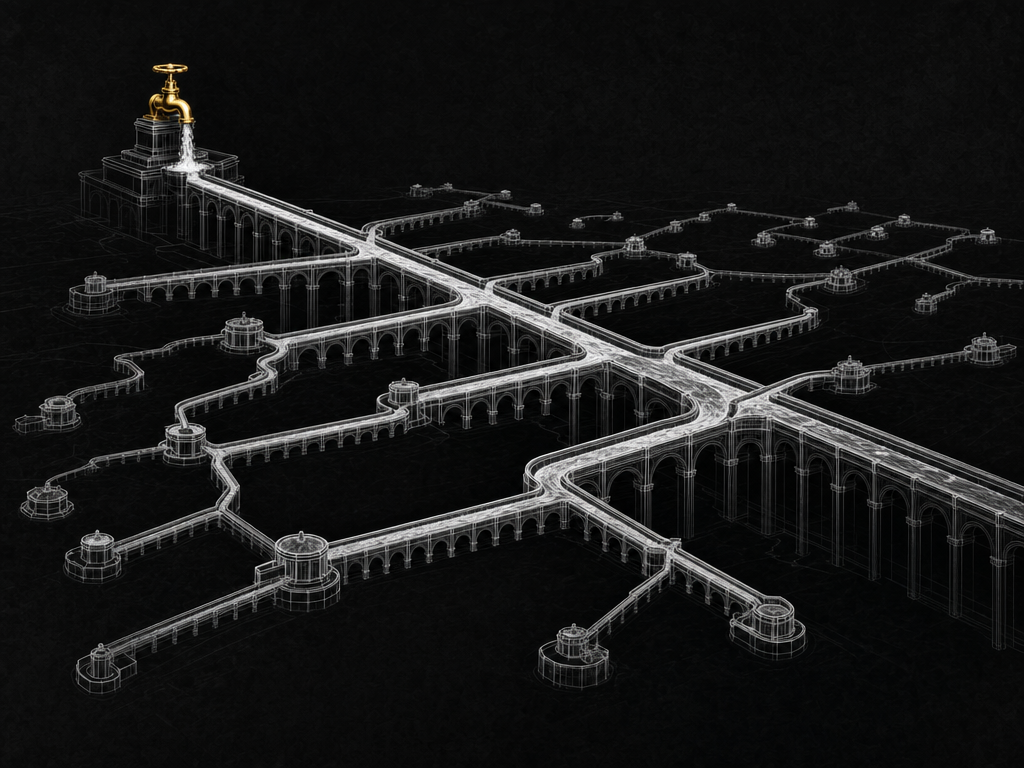

The treadmill frustration is simple: your methodology has nowhere durable to live. Why does producing more content fail to transfer methodology? Because methodology is a structural asset requiring infrastructure: AI Avatar Creation, Voice Cloning, a structured content system, and authority architecture to survive outside the expert's own delivery. Falsifiable position: more content fragments frameworks rather than scaling them. This article shows why and what a preservation layer contains.
The content treadmill is a symptom, not a strategy
The content treadmill is a symptom because output exposes the absence of architecture rather than solving it. The expert writes another post, records another short video, repurposes another talk, and still senses that the actual method has not transferred. The audience may remember a line. They may quote a phrase. But the underlying judgment, sequence, diagnostic logic, and tradeoffs remain attached to the expert's presence.
The dominant 2025 expert marketing pattern asks senior practitioners to publish more, publish faster, and let AI tools multiply the surface area. There is a plain problem with that orthodoxy: it treats visibility as if it were preservation. That observation is not a complaint about content. Content matters. But content output and methodology infrastructure are different categories.
Content output is an artifact. Methodology infrastructure is the architecture that lets the expert's framework be extracted, structured, delivered, cited, updated, and extended. A post can point toward a method. AI Avatar Creation, Voice Cloning, Content Automation, Authority Branding, and Legacy Architecture can form the preservation layer that allows the method to keep working when the expert is not in the room.
What actually happens when methodology has no home
When methodology has no home, it breaks into fragments that depend on memory, mood, and platform context. A framework lives partly in keynote slides, partly in client calls, partly in podcast interviews, partly in old notes, and partly in the expert's instinctive ability to know what belongs before what.
That fragmentation has consequences. Definitions drift. The same framework receives different names in different places. A diagnostic model appears without the conditions that make it valid. A conclusion survives without the reasoning that led to it. The expert's deeper distinctions, the parts that separate a real methodology from general advice, become scattered across yesterday's feed and last quarter's conversation.
The fragile part is not the expert's intelligence. The fragile part is the storage model. If the expert is the only person who can connect the pieces, then the expert has become the integration layer. Every audience member, client, collaborator, or AI system must come back to that person for context.
This is the delivery ceiling. It is not a failure of effort. It is the natural limit of a methodology that has no permanent structure outside the calendar, the inbox, the stage, or the social platform.
Why more content accelerates the ceiling instead of breaking it
More content accelerates the ceiling because each new artifact creates another endpoint that still requires the expert's presence to interpret it. The expert is not only producing more. The expert is creating more fragments that need later explanation.
This is why deeper thinking can make the treadmill feel faster. Simple opinions travel cleanly. A mature methodology carries conditions, exceptions, sequencing, language, examples, counterexamples, and judgment. When that material is pressed into isolated posts, the compression strips away the architecture. The expert then has to return and restate what the post could not carry.
The current oversupply of AI content tools intensifies this problem when they are used without structured extraction. A tool can draft a post from a transcript. It can generate variations of a point of view. It can imitate cadence. But without an extracted methodology, it has no reliable map of the expert's judgment. It may reproduce phrases while missing the operating logic underneath them.
This is the second hard distinction: content output creates expressions of expertise, while methodology infrastructure preserves the system of expertise. AI Avatar Creation and Voice Cloning are not merely personality replication. Content Automation is not merely volume. Authority Branding is not merely positioning. Legacy Architecture is not a sentiment. Together, when grounded in extraction, they give the methodology a durable form.
What methodology infrastructure actually is
Methodology infrastructure is the preservation layer that turns an expert's judgment into a system that can be delivered, referenced, updated, and extended. It is not a metaphor for better organization. It is a specific architecture built around the expert's frameworks, voice, proof, authority, and long-term delivery.
AZMAI's own operating model names this sequence as Extract, Build, Amplify. The Extract phase matters because methodology transfer begins before publication. It begins by drawing out the expert's frameworks, distinctions, diagnostic patterns, stories, objections, and language until the underlying architecture is visible. Without that work, the Build phase has nothing stable to build from, and Amplify risks distributing fragments.
The components are integrated, not ranked. AI Avatar Creation gives the methodology a persistent embodied delivery surface. Voice Cloning allows the expert's actual delivery style to carry structured knowledge beyond live availability. Content Automation distributes from the canon rather than inventing around it. Authority Branding connects the expert's terms, proof, categories, and public identity. Legacy Architecture defines how the body of knowledge endures, changes, and remains intelligible over time. Where appropriate, Client Acquisition Funnels connect the preserved methodology to serious commercial conversations without reducing the methodology to a pitch.
This is also why methodology infrastructure is bespoke work. AZMAI's deliberately limited client roster reflects a structural reality: extraction requires close collaboration with professionals who have real expertise and a real audience. Generic tooling can help execute parts of the system, but it cannot decide which distinctions carry the method, which stories prove it, or which frameworks deserve permanent architecture.
How infrastructure lets a framework outlast any single conversation
Infrastructure lets a framework outlast a single conversation by giving every idea a stable address, governing sequence, and renewal path. A framework can then be referenced without being reinvented, delivered without requiring a live explanation, and revised without losing its history.
A preserved methodology has continuity. The central definitions live somewhere durable. The diagnostic sequence is explicit. The examples support specific principles rather than floating as anecdotes. The expert's voice carries the material, but the material does not depend entirely on the expert's daily availability. This is the difference between being constantly present and being permanently represented.
AI avatar and voice cloning technology are available now as delivery capabilities. Their serious use is not to create a novelty version of a person. Their serious use is to represent a methodology with fidelity after the underlying knowledge has been extracted and structured. An avatar without methodology architecture is performance. A cloned voice without a preserved framework is sound. The infrastructure determines whether the representation carries judgment or merely carries resemblance.
When infrastructure is working correctly, an audience can arrive at the methodology through a keynote clip, a written article, an avatar-guided explanation, a branded framework page, or a client-facing diagnostic, and each of those surfaces points back to the same preserved canon. Updates become governed revisions rather than scattered corrections. The framework begins to behave like an asset instead of a sequence of appearances.
The moment an expert stops publishing and starts preserving
The moment an expert stops publishing and starts preserving is the moment they treat their methodology as an asset with architecture, not as raw material for the next post. This does not mean they stop creating content. It means content becomes an expression of the preservation layer rather than a substitute for it.
A practical starting point is small enough to do this week. Choose one framework you explain repeatedly. Write down its exact name, the problem it diagnoses, the sequence of steps or distinctions it contains, the conditions where it applies, the mistakes people make when using it, the stories that prove it, and the language you never want diluted. Then mark where that framework currently lives: posts, slides, calls, recordings, notes, articles, or memory.
The gap you find is the infrastructure gap. If the framework exists everywhere and nowhere, more content will not solve the problem. It will only create more places where the method can be partially understood. The serious work is to build the preservation layer beneath the output, so the methodology can keep serving people beyond any single conversation, campaign, or season of your career.
For experts ready to think differently about infrastructure and permanence: Claim your legacy